One of the unfortunate characteristics of our generation is that we have tended to live highly structured lives. Those of us born in the 1980s, who spent their twenties in the transitional era of the early 2000s, amidst the violent cacophony of the two Bush Wars, have experienced at least some shared sense of structure to our lives.
The typical life of an upper-middle class son or daughter born in Canada during that generation would go something like this: a childhood spent in public schools, with no lack of activities in which to immerse oneself (soccer, piano, theater, etc.). Then high school hits, with its swirl of hormonal desire combined with the looming pressure of standardized tests. It is generally here that the adolescent learns the rhythms of capitalist work-time: school during the day, nights filled with study and ever more structured activities.
If the student is lucky he or she will have one day a week of rest, but even at this early age the adolescent will learn what it means to work on Sundays to prepare for the coming week. For the most driven students, even one day off a week is too much. They feel nothing but the throbbing pressure to “succeed,” which at their age means to get into the best universities their country has to offer.
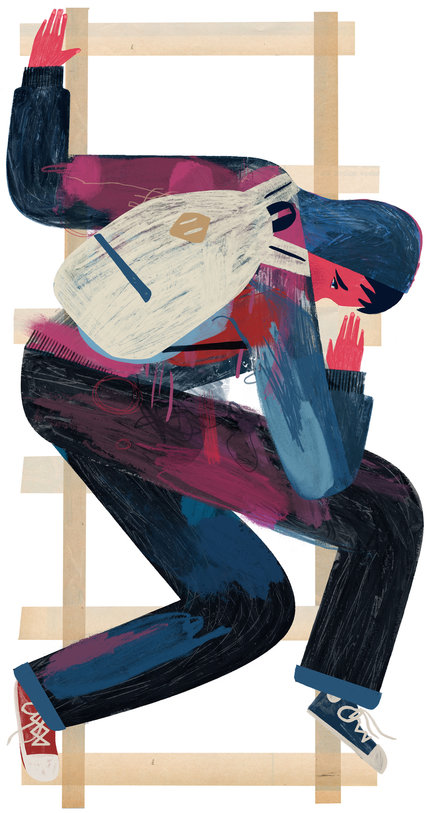
If said adolescent buckles down and grits through the stress of exams, they will find themselves in one of Canada’s storied educational institutes, which means entrance into the massive public degree factories known as McGill or the University of Toronto. Once there, they will negotiate dorm life, oversized classes, overworked TAs, dense academic prose, and the sexual freedom of early adulthood.
If the student’s family is wealthy, they may even find themselves in one of the elite universities in the United States, a Harvard, Yale, or Dartmouth, where they will encounter a level of class differentiation that will (one hopes) shock them.
The throbbing pressure of “life itself” hardly abates in college. How many young undergraduates do we see cross the thresholds of our classrooms, filled with fear in their eyes, uncertain of who “they are” and what they want “to become”? How will they make an economic life for themselves upon graduation? For the lucky few, their parents’ wealth will see them to a lifetime of comfort, but the vast majority of our students will have to grapple with the harsh realities of a market driven existence.
It is no wonder, then, that our students are obsessed with the material pressures that confront them. They equate a happy life with a stable job, and thus for the most part pursue majors that have the best employment rates: engineering, science, computer programming, etc.
Graduate school is almost a given, whether that be in the glorified trades such as law or more extensive programs in medicine and the advanced sciences. For the humanistically inclined, graduate school means advanced training in historical, cultural, or literary analysis. Visions of the great intellectuals of an older era- think Foucault and Chomsky debating political power on French television- motivate these doctoral youngsters, who all hope to achieve public prominence through their writing.
For each young person who enters the workforce, the career-long negotiation with the politics of the workplace begins. One quickly learns that all corporate structures- from the bastions of high finance to the smallest of basement startups- are hierarchical. Decision-making always tumbles downward, no matter how hard the company wraps itself in a discourse of care and empathy for its employees.
Thus our twenty somethings worry almost constantly about pleasing their bosses, groping for that next promotion even as they strive to prevent burn out. I have witnessed numerous friends who were once energized by the prospects of careers in law, marketing, and government reach points of almost physical disgust with their life choices, hollowed out by corporate structures designed to get as much labor power out of them for as small a wage. The lessons of capitalism are learned the hard way, even by our most well-educated and (because of this) most deluded young people.
Thus by the time our peers are nearing the end of the first thirty years of their lives, they face something of an existential crisis: is what I’m doing worthwhile? They have, by and large, lived in a similar manner to the other members of the educated class to which they belong: high school, undergrad, grad school, and work. They share similar dreams with their counterparts as well: finding a career “one loves,” buying a home that is “just perfect,” finding that “special someone,” and of course going out to “see the world,” if only to make them more well-rounded before they settle down to the nine to five routine.
Is there anything more hollow than the post-graduation three-week jaunt to Europe, India, or the Middle East (only the “safe” regions)? Is there anything more predictable than the endless Facebook photo tours of one’s self-actualization in Asia, where pictures of that mountain you climbed intermingle with your own reflections on your fractured childhood or unrequited loves? Our young people try to Otherize themselves for a couple of weeks, safe in the knowledge that they are returning to comfortable, if somewhat deadening, lives “back home” in Toronto, Calgary, Ottawa, or Vancouver.
These are, simply put, lives without gaps, embodied by the U of T graduate, the Queens student president, the corporate lawyer, the would be professor, the future politician, the consultant….lives shuttled from one carefully planned institution to another, from the high school to the university to the corporation to the suburb.
One fears that we are headed for lives that are fundamentally no different from those of our parents: stable jobs, incremental pay, the “miracle” of children, summer cottages, middle age, watching the teenagers grow up, retirement, more travel, and then the long march to the emptiness of death. The most astounding of us, one hopes, will produce some tremendously beautiful fiction, or shoot a socially powerful documentary, or help design just policies for impoverished others.
But we know that the realities of market life mitigate against socially just politics. We also know that it is ever so difficult to make an incursion into popular culture through aesthetic forms (which does not mean, however, that we should stop trying to do so).

The brutal reality is that most of us- the educated elite- will be destined not just for anonymity (which is not a bad thing at all), but conformity, managing our online accounts, trying not to get too squeezed at work, and resigning ourselves to the small pleasures that life can offer: the literary arts, film, real estate, kids, two weeks of vacation, our favorite team winning a championship, avoiding illness for as long as possible before our bodies break down. At best, we can look back on our lives and say “we had seventy great years, we left a family, a few books, a movie or two, made some cash and that was that…” The end.
A life lived in that manner- without any messiness, without any risk- is a minor life, a life that hardly had a chance to begin before it was over.
And yet here is the catch: it is ever so difficult to imagine a life that would be fundamentally different from the bourgeois model we have in front of us. It is, ultimately, a failure of the imagination that keeps us trapped within these conformist rhythms, ones that do nothing but replicate the unjust world that sprawls before us.
In 1986 the novelist Richard Ford properly diagnosed this imaginative failure in his novel The Sportswriter, which can best be understood as an examination of the rhythms of bourgeois depression. The story follows Frank Bascombe, a middle-aged sportswriter whose life has collapsed in on itself in the wake of the death of his son, his groping infidelities, and the failure of his marriage.
Sleep-walking through crisis in what he calls a state of “cloudiness,” he quietly searches for some kind of revelatory breakthrough. Though disengaged, he is an astute observer of the New Jersey suburbs around him and the upper-class bourgeoise that inhabit it. In describing a club of divorced men he belongs to he may as well be describing the human condition as he sees it:
In a way, I suppose you could say all of us were and are lost, and know it, and we simply try to settle into our lost-ness as comfortably and with as much good manners and little curiosity as we can. And perhaps the only reason we have not quit is that we can’t think of a compelling reason to. When we do think of a good reason we’ll all no doubt quit in an instant. And I may be getting close. (80)
Before his marriage fully dissolves, Bascombe goes to a small-liberal arts college to teach creative writing for a semester. It is in the natty micro-battles of academic careerism that Bascbombe finds the greatest examples of lives lived without imagination, human beings who cannot countenance what genuine “gaps” look like:
The fellows in my department, God knows, couldn’t have been a better bunch. To their way of thinking, I was a “mature writer” trying to get back on my feet after a “promising start” followed by a fallow period devoted to “pursuing other interests,” and they were willing to go to bat for me…I even had some confide wistfully that they wished they’d done what I did, but had never seen where the “gap” was in a young life that let you think about such a thing as being a sportswriter. All of them, of course, had gone right out of college, raced through graduate school, and as far as possible gotten jobs, tenure, and a life set for them. If they’d had any “gaps,” they didn’t acknowledge them, since that might’ve had something to do with a failure of some kind- a bad grade, a low board score or a wishy-washy recommendation by an important professor, something that had scared the bejesus out of them and that they wanted to forget all about now.
I was impressed with my colleagues’ professionalism: that they knew where all “their books” were in the library, knew the acquisitions by heart, never had to waste time at the card catalog. I enjoyed bumping into them down in the lower level stacks, gossiping and elbowing one another about female faculty, tenure, sharing some joke they’d heard or whatever scandal had turned up in TLS that week. What they did, how they conducted life, was every bit as I would’ve done if I was them- treated the world like an irrelevant rib-tickler, and their own comfortable lives like an elite men’s club.
The place was all anti-mystery types right to the core- men and women both- all experts in the arts of explaining, explicating and dissecting, and by these means promoting permanence. For me that made for the worst kind of despairs, and finally I couldn’t stand their grinning, hopeful teacher faces…Real mystery- the very reason to read (and certainly to write) any book- was to them a thing to dismantle, distill and mine out into rubble they could tyrannize into sorry but more permanent explanations; monuments to themselves, in other words. (218-223)
Bascombe here identifies precisely the kind of bourgeois culture that is, I think, at the root of our generation’s limitations: the absence of anger, passion, and activist sacrifice that comes with a comfortable and known life. As Bascombe puts it, the academics he sees around him could never imagine that moment in life where a “gap” opened up where they could do something as irreverent as write about sports for a living, to say nothing of something more sexually or politically daring. They had all “gone right out of college, raced through graduate school, and as far as possible gotten jobs, tenure, and a life set for them.”
So many of us are like the cushy professionals described in Ford’s work. Living safe, comfortable lives, in which the broad extent of our laboring energies are spent striving to get the careerist security that our parents had. We associate “gaps” with failure: the inability to find professional success, a grinding break up, the looming death of a loved one. We don’t talk about our “gaps,” none the less celebrate them, for they scare us with the ferocity with which they can upend the careful track of our lives.
Such careerist longing for safety is a political and moral detriment for our generation. Our notion of the good future has already been spelled out for us- in the plastic happiness of BMO commercials and the hollowed domesticity of a Williams-Sonoma catalogue.
For those who do get their sinecure, be it in corporate, government, or academic life, the rest of the world becomes a searingly unfortunate drama, decidedly outside ourselves, something to read about in the Globe and Mail or The New York Times. We call this looming chaos by a variety of names- “extremism,” “jihad,” “recession,” “ebola,” “socialism,” etc. But those terms all signify the same thing: disruption of the lives of dimmed but comfortable security that we all seek.
If you fear the rest of the world, if you cannot even imagine abandoning your career or your precious familial comforts in order to engage with it, in order to genuinely Otherize yourself in the face of modes of life that are different from your own…then any chance for a politics of genuine emancipation are lost. You might as well kick up on your sofa, check your Netflix account, and admit that this world of violent inequality is one you are comfortable with keeping.
So just what kind of life should we lead? Bascbome has some thoughts on the matter:
In my view all teachers should be required to stop teaching at age thirty-two and not allowed to resume until they’re sixty-five, so that they can live their lives, not teach them away- live lives full of ambiguity and transience and regret and wonder, be asked to explain nothing in public until very near the end when they can’t do anything else.
[The faculty] had all decided they really didn’t have to regret anything ever again! Or be responsible to anything that wasn’t absolutely permanent and consoling. A blameless life. Which is not wise at all, since the very best you can do is try and keep the regret you can’t avoid from ruining your life until you can get a start on whatever’s coming.
Consequently, when these same people are suddenly faced with a real ambiguity or a real regret, say something as simple as telling a sensitive young colleague they probably like and have had dinner with a hundred times, to go and seek employment elsewhere; or as complicated as a full-bore, rollicking infidelity right in their own homes (colleges are lousy with it)- they couldn’t be more bungling, less ready, or more willing to fall to pieces because they can’t explain it to themselves, or wanting to, wont; or worse yet, willing to deny the whole beeswax…Literature’s consolations are always temporary, while life is quick to begin again. (223)
This is, I submit to you, the only way forward for us: to shun entirely the blameless life of the bourgeois professional, with its shuttered view of happiness and obsessive focus on wealth and offspring. What we need to embrace are “lives full of ambiguity and transience and regret and wonder,” lives in which we take real risks to solve terrible, ambiguous questions.
If we want to solve the radical inequality our world presents to us as it is presently organized, only a radical politics will suffice. This will involve putting much of ourselves at risk, speaking truth to power, fighting against the profit motive, and opening up spaces of genuine equality in our daily landscapes. Rarely do such projects result in tenure-track jobs, comfortable corporate board positions, or material stability of any kind.
Genuine risk, and searing political regret, must become part of our life choices…we must be prepared to make the kind of sacrifices that you can’t come back from, the ones that terrify the fickle, un-courageous people who Ford diagnoses in his novel.

So I tell all of our young people: forget yourself. Give your narcissism up, for your own happiness is illusory and, quite frankly, unimportant. You will be forgotten, ground into dust, by the corporate structures that define your society, no matter how progressive they may seem. Salvation can only be found in finding a cause outside of yourself, a goal worth risking everything for.
Once you have found it, go out and immerse yourself in it. Live a life full of uncertainty and insecurity, and then come back, when you are sixty years old, to tell us all about it.
The next step, surely, is to discuss what kind of causes are worth extinguishing our lives for, so that we may gain a true sense of meaning from our existence on this planet.
I encourage our readers to submit their responses on the topic: what would you give up everything for? What risks would you be willing to take?
What is the maximal future that you can imagine, and how can you push against the structures of power that prevent it from being realized?
Mark McConaghy is a doctoral candidate in the East Asian Studies Department at The University of Toronto. He studies aesthetics, political economy, and the dynamics of historical change in the 20th century.
Student Art Downloaded From: http://ritter.tea.state.tx.us/tea/images/studentart/Jun26Jul02.html
 The 14th Floor
So damn true
This really resonates with me. Our lives are now and we need to spend it doing things we love and not be scared to step out of comfort zones. I needed to read this post 🙂 Thank you
Reblogged this on Journey With me.
Reblogged this on Capturing Life On Camera.
🙂
The first thing that comes to mind: “structures do not march in the streets,” Lacan told his student to write on the blackboard in 1968, so the story goes from my cultural studies critique class, paid in massive American debt. Lacan wrote when social change was written in the street. Collective action has become self actualization. A false self actualization, safe choices, pursuit of “happiness”.
I find myself nodding, “Yes”, so much true, while I sit reading this in a safe zone of the Middle East and Baltimore was just burned.
Reblogged this on .
Reblogged this on Mỹ Phương and commented:
What is life if it is so predictable? Mhmm..
Really good Blog post.
Reblogged this on crossbowlifecoaching.
Reblogged this on wordsbetheammo.
I must have been to the wrong kind of engineering school. Me and my fellow students were encouraged to make a meaningful contribution to humanity, not get a “safe” job. We were encouraged and empowered to start our own businesses, and I see many of my friends and classmates make the daring move and start for themselves, sometimes in areas nowhere near their major.
And me? I’ve had “gaps” in my life another life can fit in. I’ve seen change Obama would gasp about. And where I am right now? Doing a PhD in engineering, and a father of two children. And I honestly can’t think of anything riskier, anything more exciting, anything less safe, anything generating more anger, anything requiring more passion, anything demanding more sacrifice than what I do right now.
This is actually really good. XOX
This is so good 👏👏
Reblogged this on daveandoh and commented:
This is unbelievable. Very inspiring and eye opening to the truth of our coercive societal structure.
https://grievancedotme.wordpress.com/
Reblogged this on creativityandconfidence and commented:
how much more about the people living in the developing countries, like mine (philippines)
“we had seventy great years, we left a family, a few books, a movie or two, made some cash and that was that…”
Is this really your idea of a life unfulfilled?…Family, especially, building a life for others, is what brings meaning to existence…The rest is just a bonus…
basically graduate college and work for the rest of your life, earn some money and fix the health problems your office job might have caused, in your old age and die. How boring and structured indeed
Extremely well said. My husband and I have been struggling against the norm lately and have come to the conclusion that if most others are looking at us like we’re crazy, we are probably doing something right. And the truth is, all of the things we were told not to do have made us the happiest we have ever been. It’s hard to let go of that drive to succeed or feeling like you are unsuccessful because you are not climbing the financial and corporate ladders, as has been drilled into us since the moment we were born. It seems life begins on the other side…when you break through the mold, live for a greater purpose, and really contribute to society in other ways than involving materialistic objectives. It is SO hard to step out of that thought pattern that you should be seeking security and stability, but I keep trying to let it go.
It seems like the structure prevents kids from truly learning who they are (rather than knowing just what they are told they are). It’s often not easy to figure yourself out or get to know who you truly are, but we should focus on helping this generation find themselves, as that will lead to greater growth and progress and the ability to think beyond the confines of society.
In my opinion, it doesn’t necessarily have to be a financial risk, or cost a lot of money to do this. It’s more about taking a risk in personal development.
Reblogged this on asheebye's Blog.
Thank you for for helping out the few who still this way like myself
Reblogged this on matangala.
Really good
https://ghanakhazana.wordpress.com/2015/05/01/slave-trade-the-dark-ages-of-africa/
Reblogged this on Eloquent Femme.
Reblogged this on bears goats and strawberries and commented:
Wrong countries as usual. Don’t be dumb.
I think people should try for the life they want without having to take any shit about it from anyone else. I personally have thrown the proverbial monkey wrench into the machinery of my life more than once in service to the vision of what my life could be. I have yet to be satisfied and may well never be. That’s not a social issue, it’s a personal one. Lighten up, Francis.
I love the sentence – Once you have found it, go out and immerse yourself in it live a life full of uncertainty and insecurity, and then come back, when you are sixty years old, to tell us all about it.
Reblogged this on Mindfire Cantata.
Reblogged this on ingrid..
Fight for fifteen. No to universal surveillance. Save us from drastic climate change. Yet I have all the compromises of years of alcoholism and poverty holding me back from both structured career and risk taking.
Reblogged this on No Filter May.
Reblogged this on Hello Holli Hello and commented:
This is amazing stuff. If you are in your 30’s you need to read this now.
Reblogged this on pointblanklife.
good
best
Nice
Reblogged this on making sense.
Reblogged this on sleekerthanthou.
Reblogged this on rashadimani.
Loved reading this! It out so clearly into words exactly what I was thinking in my head.
Very interesting article.
But I think things are shifting quite quickly in the marketplace – there are very very few “safe” tenure-track jobs, there are very few “safe” anything jobs. Increasingly work is moving to things like short-term contracts.
So I suspect many people will be forced to take risks, and / or make big noise about rising work instability and sinking wages, or at least, an impossible balance between cost of living and salaries.
“May you live in interesting times…”
Excellent points. Our Editorial Board recently wrote on a similar topic for our college newspaper. I think the difficulty is that we measure success in terms of academic accomplishment or workplace position. For many of us though, that can come through raising a family or writing a novel in our spare time. There are so many ways to be successful, but the busyness and continuance of “GOING” will bring even the best intentions to a halt. Well done.
Reblogged this on daniraerae and commented:
Really neat read.
Hi there! I am doing a school project. My school project is to start a WordPress blog. So please look at it and give me some feedback!
Thanks:)
Sarocchiii.wordpress.com
I think your words here shine light on things that many people (myself included) have swept under the rugs just because we’ve been told that’s how it’s done. For some, it works. For others, we find that alternative methods are far more resonating; it’s just extremely difficult to break habits that have been carved into our very being. And to do so, takes risk and sacrifice, at a very high cost, it seems.
Your call to action reminds me of Plato when he talks about the philosophy of leisure/play. Are all the things we doing in life, leisure/play included, good/real or bad/false; that is, are we living lives which guide the future toward justice and the pursuit of all that is good?
Thank you for posting.
Reblogged this on missmrsmissmum.
Reblogged this on layaqat786's Blog.
Reblogged this on sparkling petals.
Reblogged this on pradeepparik and commented:
India to Canada, the tyranny is the same